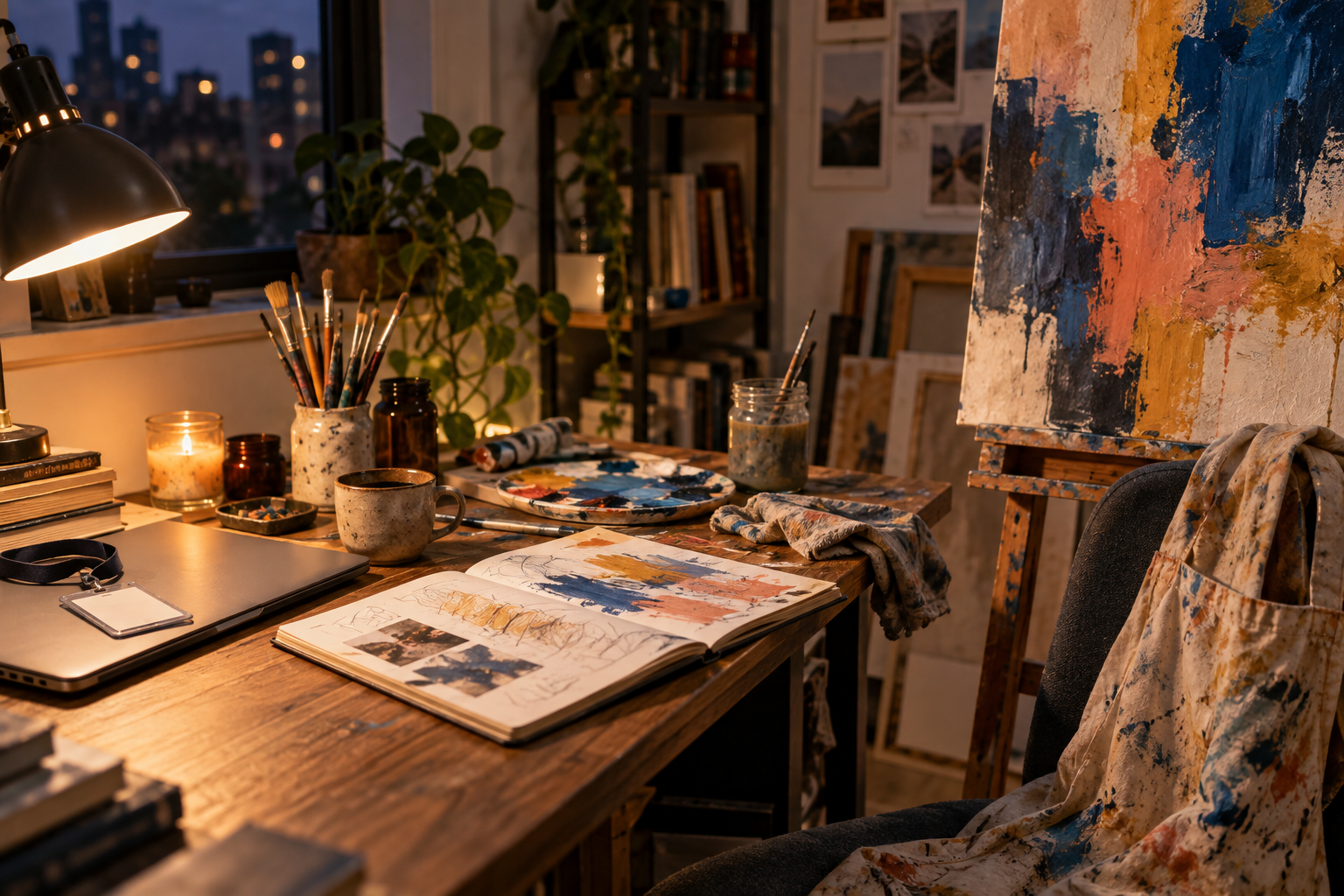
I usually get into the studio at the least cinematic time possible. Dinner is finished, the email notifications have slowed down, and I am already a little tired. There is no dramatic burst through the door with a fresh canvas under my arm. I change into an old shirt, make coffee I probably do not need, and stand in front of whatever I left unfinished on Sunday.
This is the rhythm behind most of the work on this site. I have a regular job and I paint around it. For years I thought that arrangement made me less serious than artists who worked in a studio every day. Now I think the limits are part of the practice. They make me pay attention, make decisions faster, and return to a painting with enough distance to notice what I could not see the night before.
The fantasy of waiting for more time
I spent a long stretch telling myself I would make more art when life became less busy. That sentence can survive for decades. There will always be a demanding week, a house repair, an appointment, or a reason to clean the garage before setting up an easel. Eventually I realized that the imaginary future with endless time was not coming. If painting mattered, it had to fit inside the life I already had.
That changed the question from “How do I find a free weekend?” to “What can I do in forty-five minutes tonight?” Forty-five minutes is enough to mix two colors, paste down a piece of paper, cover an area that is too polite, or make one drawing. It is not enough to control the whole outcome, which is probably good for me.
What the day job gives the paintings
A normal working day gives me material. I notice the repeated geometry of office windows, lane markers seen from a car, loading areas, patched asphalt, utility boxes and the fluorescent color of a safety vest. None of that sounds romantic, but it often ends up in the paintings. The East Bay is full of strange overlaps: dry hills behind distribution buildings, a pale sky above BART tracks, garden plants pushing against concrete walls.
Work also keeps me in contact with people whose lives have nothing to do with painting. That matters. The studio can become a room where every decision feels enormous. A conversation about a printer problem or weekend errands is an effective reminder that the world will continue even if I ruin a canvas. That makes it easier to take a risk.
The difficult first twenty minutes
The hardest part of an evening session is beginning. My brain is still carrying the shape of the day. I want to check messages, reorganize brushes, or convince myself that reading about art counts as making it. I have learned to begin with a task that does not require inspiration. I can cover yesterday’s marks with a thin wash, cut paper into rough shapes, or clean a palette while looking at the work.
After ten or twenty minutes, the painting usually starts asking better questions. A dark line needs to move. A blue area is too cool. The collage edge is doing something more interesting than the brushwork beside it. I stop thinking about whether I feel creative and start responding to what is in front of me.
Why I do not finish everything in one session
Short sessions naturally divide a painting into chapters. Acrylic dries quickly, but glue, thick passages and my own judgment do not. Leaving the room can be useful. In the morning I sometimes glance at the work before leaving and immediately see a problem that was invisible at 10:30 the night before.
I keep a small notebook near the door and write one sentence about the next move: “lose the hard edge,” “bring back the hill line,” or “do not add more orange.” The note is not an order. It is a breadcrumb that helps me enter the work again without spending the next evening trying to remember what I meant to do.
Weekends are for the messier decisions
Weeknights are good for contained moves. Weekends are when I can spread paper across the table, work on two or three pieces, scrape off a failed layer, and wait for things to dry without watching the clock. I often use Saturday morning to make collage material: painted sheets, ink marks, rubbings and scraps that may not have a destination yet.
The longer block of time is valuable, but it works because the smaller weeknight sessions keep the thread alive. If I only painted on perfect Saturdays, every session would feel like a special event that had to produce a masterpiece. Working on an ordinary Tuesday lowers the stakes. It is just the next visit.
Being serious without turning it into another job
I take painting seriously. I keep records, buy decent materials, photograph finished pieces, submit work occasionally, and try to understand what I am doing. But I do not want to recreate the pressure of a second full-time job. Not every painting needs to become inventory, content, or proof of progress.
Some panels are experiments. Some are terrible. A few get cut up and return as collage in another piece. This blog exists partly to show that middle area, because finished images can create a false story in which an artist moves smoothly from idea to result. My actual process is loops, wrong turns and small recoveries.
Why I am not quitting
People sometimes ask whether the goal is to leave my job and paint full time. It is a fair question, but my honest answer is no, at least not as a grand plan. A paycheck gives the studio breathing room. I can let a painting take longer, make work that is not immediately sellable, and say no when a project does not fit.
The balance is imperfect. There are weeks when I barely paint, and stretches when work drains more energy than I want to admit. Still, the two parts of life support each other more than they compete. Painting gives me a place where usefulness is not the only measure. Work gives the paintings friction, structure and contact with the ordinary world.
A practice built from returns
I used to measure commitment by hours. Now I measure it by returns. Did I come back after a bad painting? Did I open the studio after a long day? Did I stay curious when the first idea failed? The work grows from those returns, not from a dramatic declaration.
If you also make art around a job, family or another demanding part of life, your practice does not need to resemble anyone else’s schedule. Fifteen minutes counts. A sketch on a lunch break counts. Looking carefully at the color of the hills on the drive home counts. The point is not to pretend time is unlimited. It is to keep a door open and walk through it often enough that the room still feels like yours.