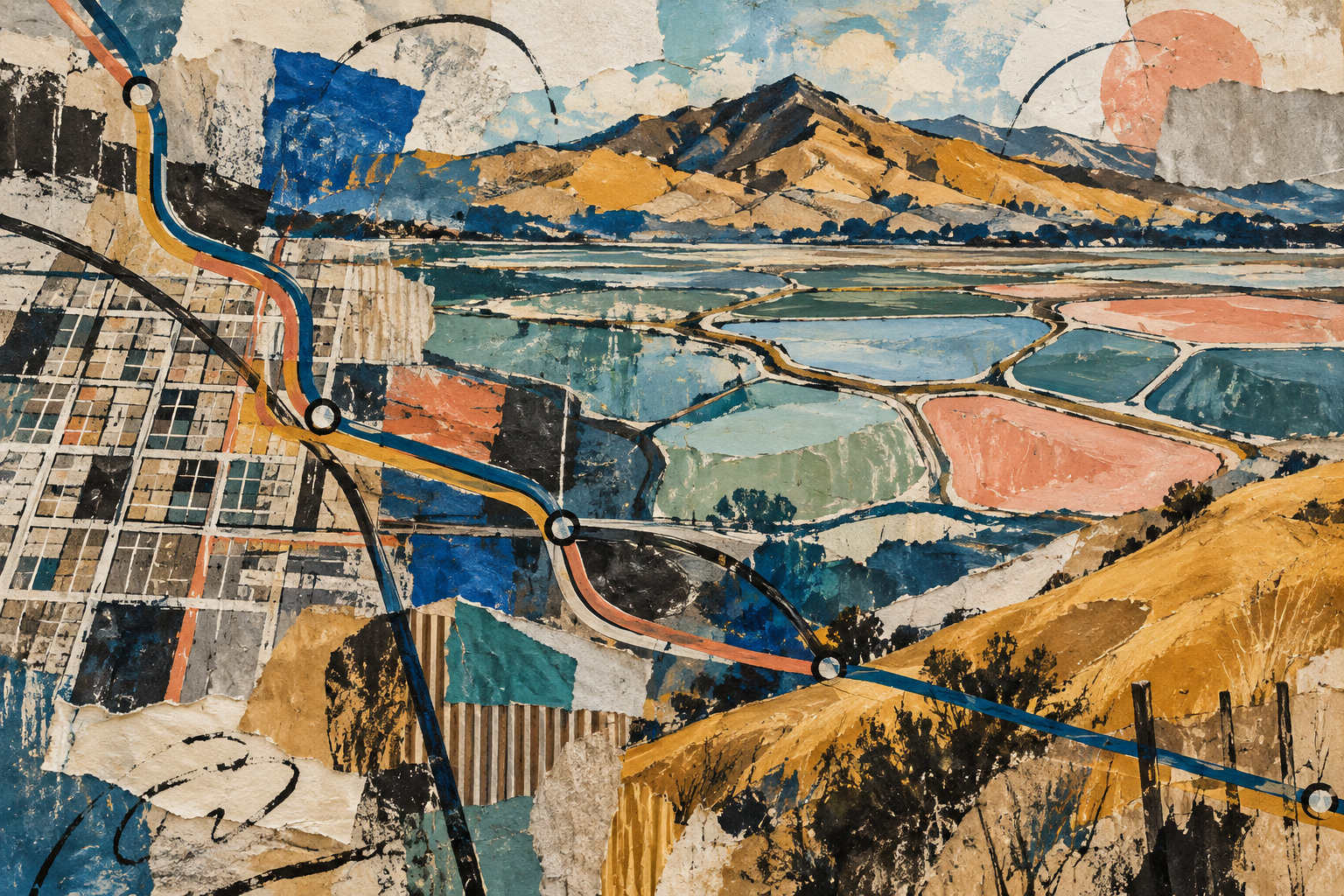
I do not paint many recognizable landscapes. You will rarely find a precise skyline, a named trail or a careful portrait of a building in my work. Still, the East Bay appears everywhere. It shows up as a dry gold wedge, a line crossing a pale field, a rectangle of salt-pond color, or a black mark that began as a freeway support.
These five places are not a definitive local guide. They are simply the locations I return to physically or mentally. Some are beautiful in the expected way. Others are ordinary pieces of infrastructure that become interesting after enough repetition. Together they form the visual vocabulary I carry into the studio.
1. Mission Peak from the streets below
Mission Peak is the obvious Fremont reference, but I am usually more interested in seeing it from a parking lot or between houses than standing at the top. From below, the hill is a large shifting plane. In summer it turns gold and seems almost flat from a distance. After rain, the green is so sudden that it looks temporarily borrowed from another climate.
I use that long sloped shape constantly. Sometimes it becomes the dominant ochre area in a painting. Sometimes it is only a diagonal separating two color fields. The trails and utility lines create dark interruptions that keep the hill from becoming a postcard. I like the tension between the ancient-looking landform and the very current city pressed against it.
2. The salt ponds near the bay
The salt ponds are a lesson in color that does not behave politely. Depending on season, water, algae and light, the ponds move through muted blue, green, rust, pink and a chalky near-white. Seen from a trail or from above, they are divided into geometric sections that look designed even though weather and industry have both shaped them.
In the studio, the ponds often become rectangles of translucent color. I use tissue or thin paper for those sections because the layers underneath remain visible, the way shallow water reveals and obscures at the same time. Black lines between the shapes suggest berms, roads or a map, but I try not to explain them too completely.
3. BART tracks and station edges
There is a particular kind of looking that happens while waiting for a train. You notice the yellow strip, the repeating columns, the rails narrowing into distance, bits of signage, weathered concrete and people briefly framed by doorways. It is not a peaceful landscape, but it has a strong visual rhythm.
BART appears in my work as repeated bands and interrupted lines. I sometimes roll black ink across a panel, then cover sections so only fragments remain. The line seems to travel behind the painting and return elsewhere. That feels closer to the experience of transit than drawing a train would: connection, disappearance, repetition and a little uncertainty about the schedule.
4. Niles Canyon and the older edges of Fremont
Niles has a different pace from the broad roads and newer developments around it. The canyon, creek, railroad history, smaller buildings and old commercial details create a denser collection of textures. I notice faded paint, stone, shadow under trees and the way the road bends rather than holding a straight grid.
This area influences the collage side of my work. Torn paper feels suited to places where different eras sit next to each other. A printed fragment under a wash can suggest history without illustrating it. I also borrow the narrower, more enclosed feeling of the canyon when a painting needs compression instead of another wide horizon.
5. The unremarkable roads between places
The fifth spot is not one location. It is the collection of frontage roads, intersections, sound walls, warehouses, school fields and strips of landscaping seen while moving through the East Bay. These spaces are easy to dismiss because they are built for passing through. That is exactly why I keep watching them.
A coral construction barrier against gray asphalt can determine a palette. The shadow under an overpass can become a blunt dark block. A line of young trees supported by stakes can turn into a series of ink marks. I take quick phone photos when stopped, but most of the time I rely on memory. Memory removes the details and leaves the structure.
How a place becomes a painting
I do not usually return from a walk and paint the scene. The process is slower and less direct. I collect color notes, rough sketches and photographs. Later, while working on something unrelated, one shape or relationship returns. The dry hill becomes a torn ochre paper. The salt pond becomes a cloudy teal glaze. The overpass becomes a heavy line that the rest of the painting has to answer.
This delay is useful because it prevents the source from becoming an instruction. I want the painting to stand on its own, even if nobody recognizes Fremont in it. Local reference gives me a starting pressure, not a destination.
Looking locally without becoming sentimental
Painting where you live can slip into easy affection. The East Bay has dramatic light and beautiful open land, but it also has congestion, construction, expensive housing, industrial edges and rapid change. I do not want to remove those contradictions. A rough black line through a pleasant color field may be the most honest part of the image.
The local art community helps with this. Seeing work made by people who live nearby reminds me that a place has many versions. One artist focuses on ecology, another on family history, another on the built environment. My view is just one set of evening drives, weekend walks and repeated visual habits.
A small practice for finding your own five places
If you make art and feel short of subjects, choose five places you encounter regularly. Do not select only the impressive ones. Include the view from a bus stop, the alley behind a store, or the corner where late light hits a blank wall. Visit at different times and write down colors, shapes and sounds rather than trying to make a finished sketch.
Back in the studio, use one observation without illustrating the whole scene. Borrow a proportion, a boundary, or two colors that should not work together. Place can enter abstract work through structure as much as image. The more carefully I look at Fremont and the East Bay, the less ordinary they become, and the less I need to paint them literally.